Magnesium is one of the lightest structural metals, offers excellent recyclability, and holds strong potential for a wide range of industrial uses. Despite these advantages, its application has remained limited so far. The main reason lies in its restricted formability, which causes conventional manufacturing processes – especially in wire production – to reach their limits quickly.
An international research project is addressing this challenge. Its goal is to gain a deeper understanding of the material behaviour of the calcium-containing magnesium alloy ZAX210 across the entire process chain and based on this knowledge, to develop more efficient processing strategies. At the LKR Light Metal Competence Centre Ranshofen, part of the AIT Austrian Institute of Technology, simulation-based methods are used to analyse how microstructure and texture evolve from casting to wire drawing.
In recent years, notable progress has been made through the development of new alloy concepts. In particular, the addition of calcium has been shown to enhance both formability and texture development. The Mg-Zn-Al-Ca alloy ZAX210 demonstrates significantly improved formability compared to conventional magnesium alloys, due to the targeted control of microstructure and recrystallisation. Nevertheless, a comprehensive understanding of its behaviour under real industrial conditions is still lacking.
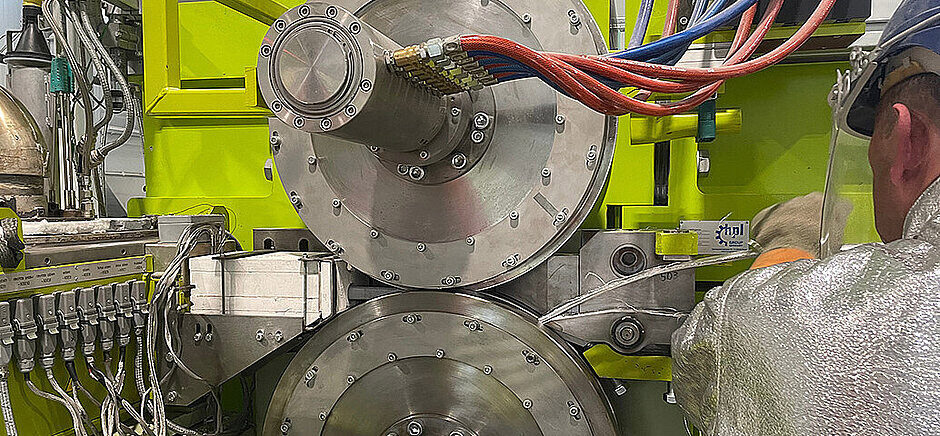
Developing an innovative process chain for ZAX210
The project ‘Material behaviour along the process chain of ZAX210 wire’ is the first to systematically investigate the production of magnesium wire based on the ZAX210 alloy. The focus is on a novel process chain that combines twin-roll casting (TRC), continuous rotary extrusion (CRE), and subsequent wire drawing.
TRC integrates casting and hot forming into a single step, enabling the production of a homogeneous starting material with an optimised microstructure. CRE, in turn, is a resource-efficient continuous forming process whose effects on microstructure and texture have not yet been fully explored.
By promoting dynamic recrystallisation in a targeted manner and controlling texture development, the project aims to achieve improved formability alongside high mechanical performance. This opens up new application areas for magnesium wire, including medical technology and wire-based additive manufacturing.
LKR’s contribution: Simulation across the process chain in its entirety
LKR contributes its extensive expertise in forming technologies as well as microstructure and texture simulation to the project. On the macroscopic level, individual process steps are modelled using adapted forming and extrusion simulations to systematically assess the influence of key process parameters.
At the same time, the LKR examines microstructure evolution along selected flow lines. This includes the analysis of grain morphology, phase proportions, texture changes, and recrystallisation mechanisms. The Visco-Plastic Self-Consistent approach is applied, providing an efficient framework for describing anisotropic material behaviour. This makes it possible to realistically capture complex phenomena such as dynamic recrystallisation and twin-induced recrystallisation.
By combining macroscopic process simulation with microscopic material modelling, a comprehensive understanding of the interactions between process control, microstructure, and resulting material properties is achieved.
Aluminium and magnesium also play a key role as recyclable materials, offering significant potential for a sustainable circular economy. Accordingly, research activities focus on these two light metals in order to enable efficient, safe, and environmentally friendly mobility solutions.
Main project partners and funding
The project partner is the Institute of Metal Forming (IMF) at TU Bergakademie Freiberg. Funding is provided by the FWF WEAVE programme, with a main submission to the German Research Foundation (DFG) and co-financing from the Austrian Research Promotion Agency (FFG).
