Gregor Brümmer, Rainer Thomas and Klaus Scheiblauer.
Methods of investigation from other sciences adapted for the foundry industry have a long tradition and have always yielded new insights. Mineralogists’ research on inclusions in rocks has proved its worth in determining the formation conditions of mineral zones. Raman spectroscopy is particularly suitable for investigating them, which, with a few exceptions, is unknown in the foundry industry. The best-known inclusion of cast iron is graphite and so it was obvious to take a look at it through the Raman spectrometer. This allowed interesting insights to be gained [1], but even more surprising was the finding that phases occur in cast iron that should not be there, including small diamond-like structures in the matrix with a size ranging from less than one to over 20μm in diameter (figure 1) [2], [3].
Further investigations revealed that these inclusions, spectrometrically identified as diamonds, are resistant to hydrochloric acid and appear bright in reflected light, making them easy to miss. In addition to these, other phases such as calcite and within this in turn hydrocarbons such as methane and benzene were found. All these phases which, according to common understanding, can only exist under high pressures in an environment of a hot material such as cast iron.
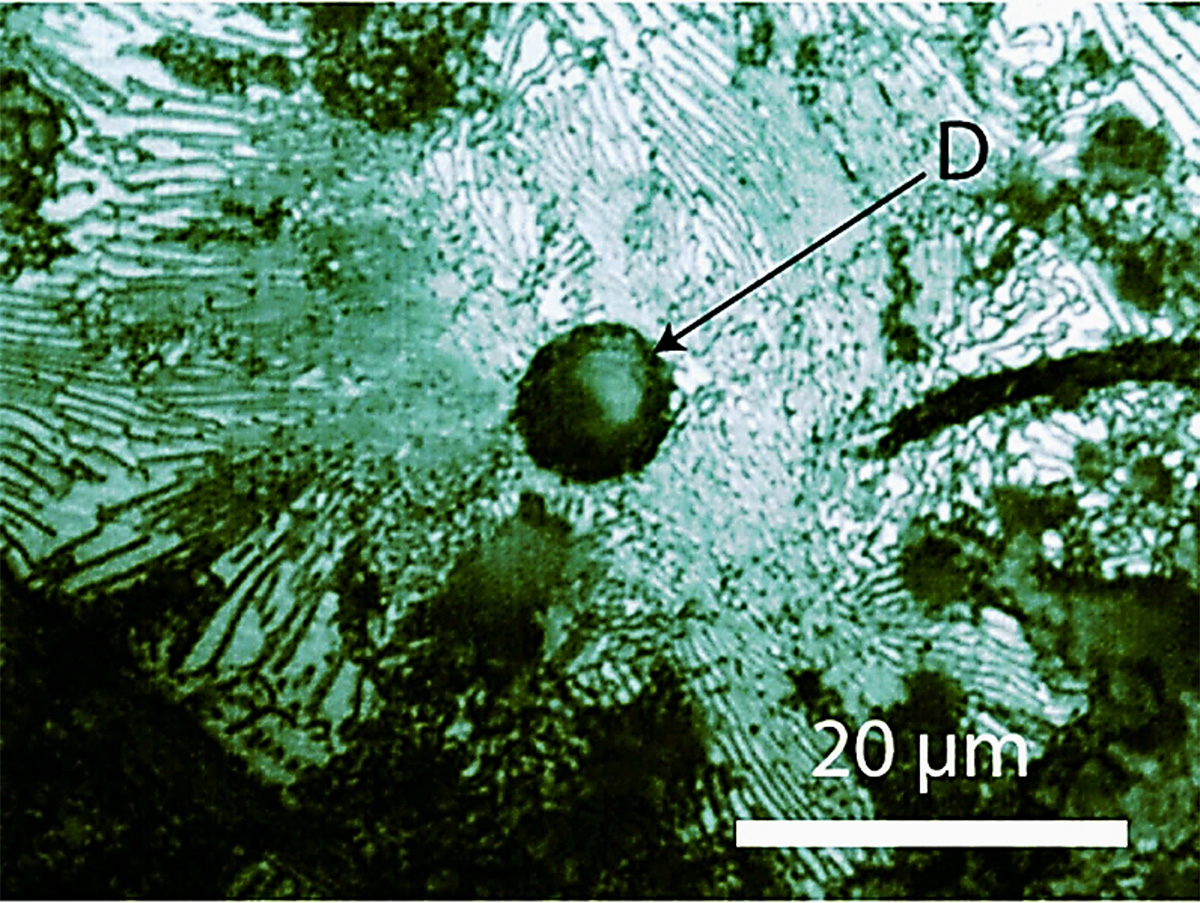
Figure 1.: Spherical isolated single diamond grain (D) in a pearlitic grey cast iron matrix of sample No. 5. The diameter of the diamond grain is 8.5µm. In this sample, there are more isolated single diamond crystals, which are generally spherical
During the solidification of cast iron at 150°C, pressures in the range of a few GPa are hardly possible, but iron has a special feature. When the eutectoid transformation temperature is reached at about 750°C, the matrix changes its crystal structure from cubic face-centred to cubic inside-centred. This is associated with an increase in volume of about 8% in theory, less in reality of a carbon-saturated crystal doped with silicon, but still roughly estimated at 2 to 3%. At the same time, the carbon solubility of the matrix drops abruptly by about 0.5%.
This means that the conversion of austenite to ferrite results in considerable stresses within the structure, which obviously lead to a drastic short-term pressure build-up in small parts of a casting and force the elements carbon and hydrogen fleeing from the matrix to form joint phases, which can then be hidden in slag particles, or the carbon crystallises as diamond. After the overpressure has been released into the environment by deformation, the structure formation will fall back to the familiar path, the remaining carbon will diffuse more slowly from the supersaturated matrix and deposit as graphite on the eutectically formed spheres or lamellae or, in the case of impaired diffusion, lead to cementite in the form of perlite.
The fact that the synthetic formation of diamond preferentially takes place in the vicinity of FeSi or FeSiNi alloys even at low pressure has been proven by various studies (e.g. [4]). This closes the circle between geoscience, physical laboratory and foundry practice and makes it plausible that diamonds appear in cast iron, where they precipitate under higher internal pressure, but probably not at standard conditions needed to transform carbon to diamonds.
Literature:
[1] Brümmer, G.; Thomas, R.; Scheiblauer, K.: Wie wächst er nun? Der Graphit im Gußeisen unter dem Raman-Spektroskop. probably Giesserei-Rundschau Nr 4, 2025
[2] Thomas, R.; Brümmer, G.; Scheiblauer, K.: Unexpected carbon phases in grey cast iron – diamond, calcite, and methane. Geology, Earth and Marine Sciences. 2025, 7 (4): 1-6.
[3] Thomas, R.; Brümmer, G.; Scheiblauer, K.: Paradigm change of pegmatite formation -where does the water come from? Geology, Earth and Marine Sciences. 2025, 7 (5): 1-7.
[4] Yang, Y et. al: Carbon adsorption on doped cementite surfaces for effective catalytic growth of diamond-like carbon: a first principles study. Phys. Chem. Chem. Phys. 2017, 19, p. 32341-32348
For further details contact Garth Sinclair of Met-Link on 082 463 2315 or email garth@met-link.com
