Developed for a demonstrator vehicle for a British OEM and revealed at ‘Casting the Future of Aluminium’, hosted at the University of Sheffield’s Advanced Manufacturing Research Centre (AMRC), the cast aluminium subframes are 17% lighter at the front and 35% lighter at the rear than the components they would replace.
The subframes were created using a combination of casting design techniques developed by Pivot’s lead partner, Coventry-based foundry Sarginsons Industries and Siemens’ topology optimisation technology, including Simcentre Optistruct and Simcentre Inspire software.
Leveraging a proprietary database of mechanical property data compiled over 20 years of physical testing and microstructural analysis, the technology enables Sarginsons to predict how aluminium will behave throughout a casting. This capability enables structural components to be validated in virtual crash-simulation environments before any metal is poured.
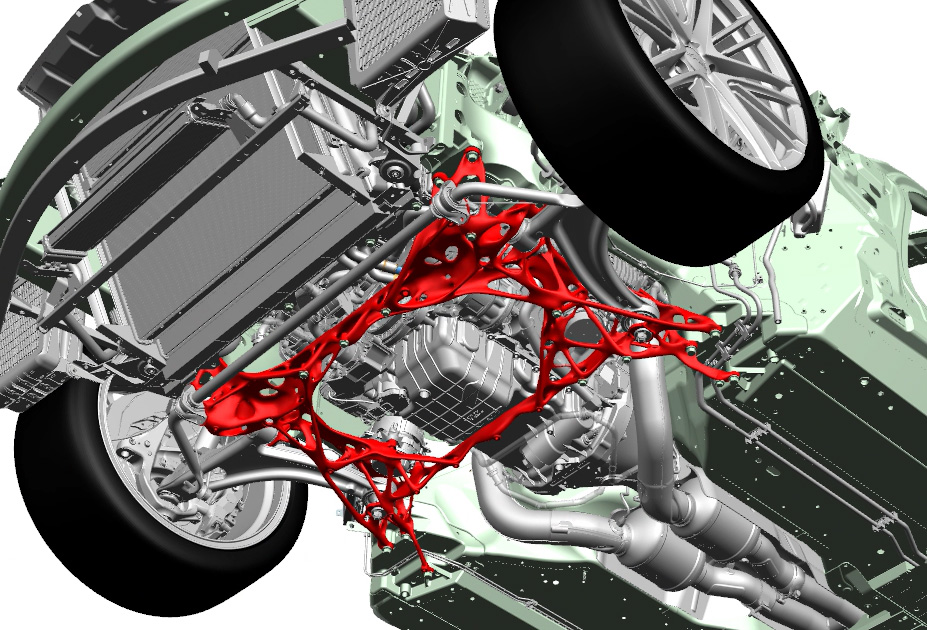
Pivot consortium is showcasing the transformative potential of advanced casting technologies for the next generation of vehicles
Replacing conservative assumptions with material-specific performance data helps the process reduce the need for over-engineering, unlocking lighter, more cost-effective, and higher-performing structural castings.
The reveal was made by Pivot at ‘Casting the Future of Aluminium’, a closed cross-sector event convening senior figures from the automotive, aerospace, and defence industries, funding bodies and the metals sector to explore collaborative opportunities in advanced aluminium manufacturing.
Sarginsons’ technical director, Gavin Shipley, said, “A physical crash test can cost up to £1 million every time you run one. For decades, the only way to be safe was to over-engineer, adding mass and material to compensate for uncertainty.”
“What we’ve demonstrated today is an alternative. By combining virtual engineering, AI and advanced casting expertise, we’re able to understand precisely how a component will behave before any metal is poured, giving manufacturers the confidence to design for real performance rather than worst-case assumptions.”
“For decades, engineers have been forced to design around the limitations of casting. We’re now turning that thinking on its head, unlocking entirely new possibilities for lighter, stronger and more efficient vehicle structures.”
Following completion of the virtual development programme, the front subframe will enter the next phase of development, with tooling scheduled to begin soon. The components will also undergo physical durability testing and be fitted to demonstrator vehicles for track evaluation, providing real-world validation of the virtual engineering approach used throughout the programme.
