Volvo officially becomes the first European OEM to adopt Tesla style gigacasting.
When Volvo Cars recently presented the new EX60, it marked more than the launch of a new vehicle model. It also signalled a clear technological shift in the global automotive industry. At the same time, it highlights an area in which research at Chalmers University of Technology is playing an increasingly important role.
One rear structure in a single piece
The EX60 will be the first Volvo model to use so-called megacasting. Instead of assembling the rear structure from 60 to 100 welded steel components, these are replaced by a single, large high-pressure die-cast aluminium structure. The result is fewer joining processes and lower manufacturing costs. Until now, the technology has mainly been associated with Tesla and Chinese manufacturers. The EX60 therefore represents a clear European breakthrough, with production taking place at the Torslanda plant in Gothenburg.
More than a manufacturing method
Megacasting is not merely a production innovation, it can also give a strong push for sustainability. The technology places new demands on materials development, advanced simulation, and a deep understanding of thermal processes, structural performance and repairability. These are areas in which Chalmers has strong expertise.
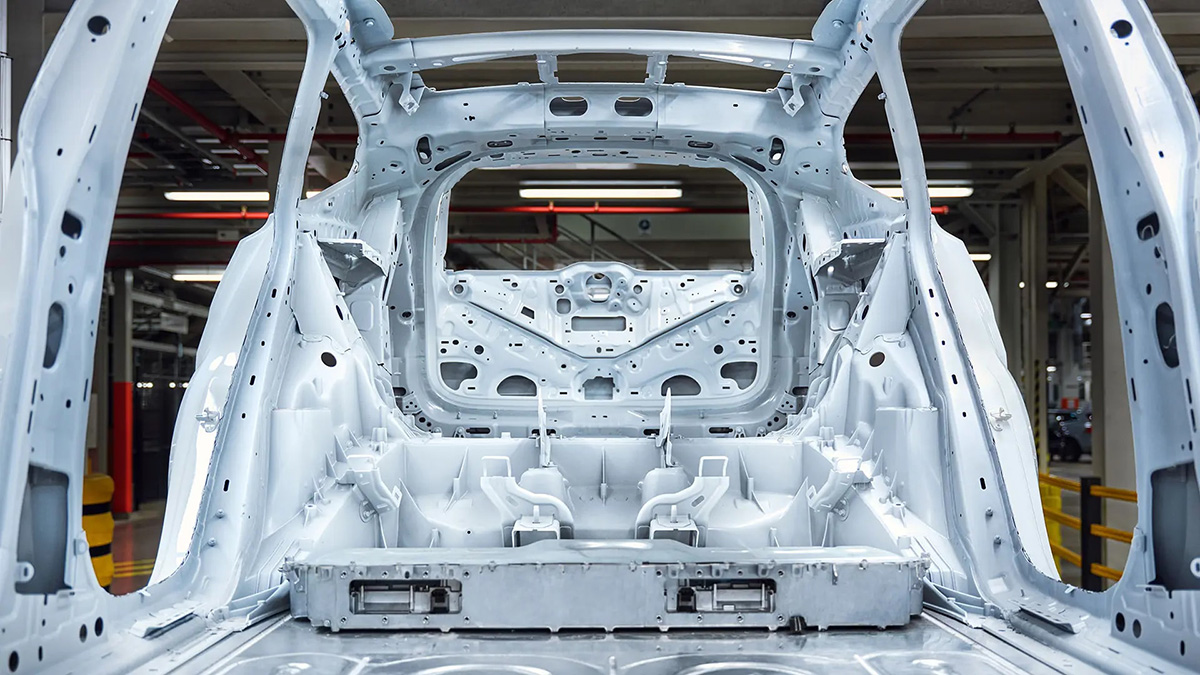
Megacast body part for rear floor section of a Volvo EX60. Photo: Volvo Cars
In just 2.5 years, research in this field has grown from zero to a project portfolio of approximately SEK 50 million, with an annual volume of around SEK 10 million. Funding is provided by, among others, Vinnova through initiatives such as Net Zero Industry and FFI, as well as by Mistra, WISE, SSF and WISE/WASP.
“Our research focuses on developing circular materials solutions that make it possible to use more recycled aluminium in advanced, high-performance products. This is an important part of reducing both climate impact and resource use in the automotive industry. By combining modelling with experimental testing, we contribute to the development of new manufacturing technologies, such as megacasting, with a lower environmental footprint.
The growing interest from industry, together with our collaboration with Jönköping University and RISE, points to continued growth,” says Lars Nyborg, Professor of Surface Engineering at Chalmers University of Technology.
Opportunities for research and collaboration
Taken together, the Volvo EX60 illustrates how the industry’s transition towards electrification, simplified production and greater system integration is creating new research questions and new opportunities. For Chalmers, the focus is not on developing individual components, but on contributing the knowledge required to enable the next technological shift.

Industrial environment at Volvo Torslanda
“This is a good example of how a large company takes responsibility for future development by engaging suppliers, universities and research institutes. Research and education strengthen competence and contribute to better products and increased competitiveness in the long term,” says Johan Ahlström, Professor of Materials Science at Chalmers University of Technology.
