In April (30 days) 2025, the world’s primary aluminium production decreased by 3.27 per cent M-o-M despite no decline recorded in daily average output. According to IAI, the world’s daily average aluminium production in April was 201 100 tons, remaining flat compared to 201 200 tons in March. However, on an annual basis, the output increased by 2.25 per cent, showed the International Aluminium Institute (IAI).
Decoding the output trend of April
According to IAI data, the world primary aluminium production in April was 6.033 million tons, compared to 6.237 million tonnes a month ago and 5.9 million tons a year earlier. Throughout the year so far, the world primary aluminium production recorded the second monthly fall, but it is important to analyse if this has been a trend over the years or one-of-a-kind situation.
If compared to April 2024, the world’s primary aluminium production witnessed M-o-M fall of 3.1 per cent from 6.089 million tons to 5.901 million tons. This indicates that the world production also decreased last year in April, and at the same rate of 3 per cent. The trend repeats for the third year in a row as the world primary aluminium production also saw a 3 per cent downfall in April 2023.
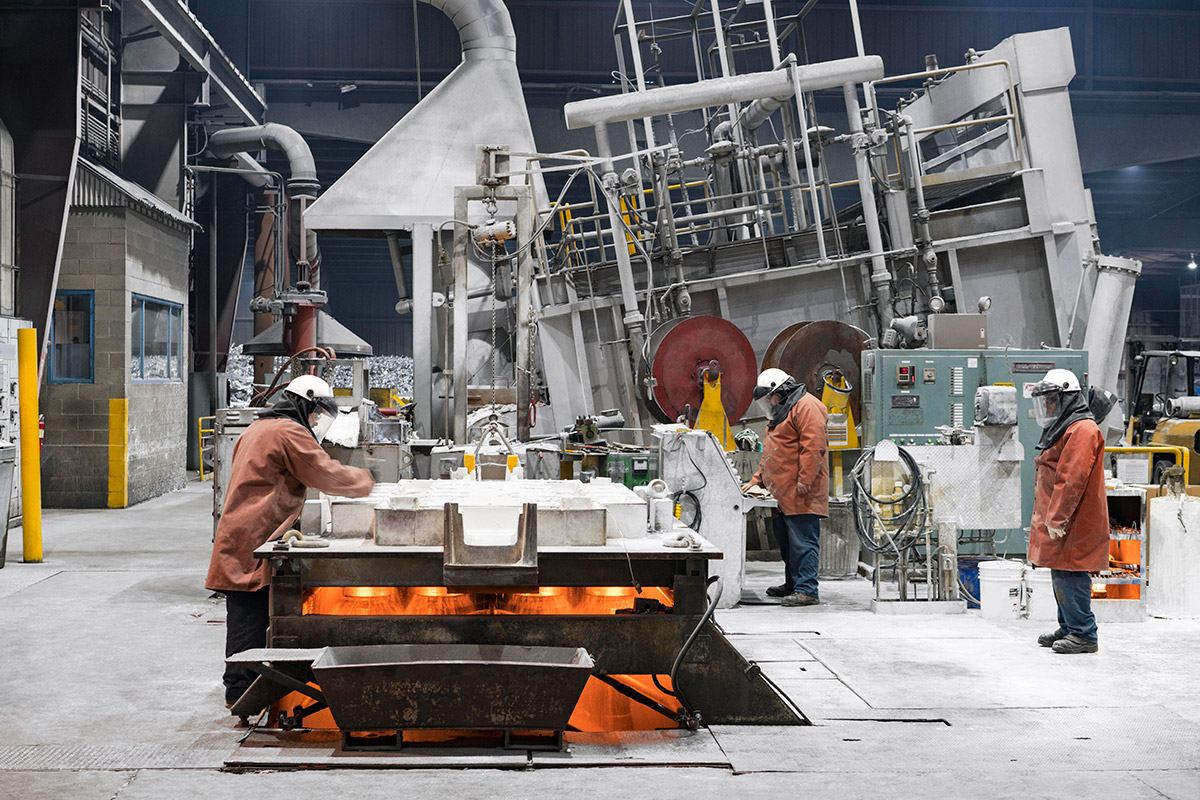
Casting of aluminium at a Hydro plant
Who drove the monthly decline in April?
If we follow the Y-o-Y trend, except Africa, all the other primary aluminium producing-regions recorded M-o-M fall in both April 2024 and April 2025. In the North and South America, primary aluminium production in April 2025 fell 3.26 per cent and 4.6 per cent M-o-M, amounting to 326 000 tons and 125 000 tons. The declining rate in North America mirrored the same as in April 2024, while South America’s output this year recorded higher declining rate compared to 3.15 per cent in April 2024.
In Europe (including Russia), primary aluminium production in April 2025 slumped by 2.9 per cent M-o-M, compared to 3.02 per cent of decline in 2024. In April 2025, Europe produced 578 000 tons of primary aluminium versus 595 000 tons of output in March, whereas the output in the previous year stood at 6.089 million tons and 5.9 million tons.
Both China and Asia (ex-China) also saw M-o-M declines in April 2025, reflecting the previous year’s trend. In April 2025, China and Asia’s (ex-China) primary aluminium production stood at 3.621 million tons and 398 000 tons, reflecting M-o-M downfall of 3 per cent and 4 per cent. The declining rate in Asia, however, decreased Y-o-Y compared to 7 per cent of downfall during the corresponding period of the previous year.
The GCC countries also recorded M-o-M fall of 3 per cent in April 2025, amounting to 505 000 tons, mirroring the trend seen in April 2024, when output fell from 537 000 tons to 519 000 tons.
Is there any particular reason for the downtrend?
While the aluminium industry typically operates without a clearly defined off-season, April has historically seen a moderation in primary aluminium production. This trend could be attributed to seasonal dynamics, including planned maintenance schedules and temporary output reductions at various smelters during the spring months.
However, the production landscape in April this year has been shaped by more pronounced structural headwinds like tariffs, which have exerted downward pressure on output across multiple regions. These trade measures have not only strained operating margins but, in some cases, compelled producers to suspend operations.
Compounding these challenges is the situation in China, as the country has neared the government-mandated cap of 45 million tons of primary aluminium capacity.
