For all the futuristic promise of additive manufacturing, the industry has faced a mundane but stubborn problem: 21st-century printers are often forced to run on 20th-century “ink”. Most aluminium alloys used in 3D printing today were originally designed for traditional casting methods, where metal cools slowly in a mould. When these standard materials are subjected to the turbulence of Directed Energy Deposition (DED), a printing technique involving intense heat and rapid cooling, they frequently develop microscopic cracks or structural weaknesses.
But Prof. Peter. D. Lee, Prof. Chu Lun Alex Leung, Dr. Da Guo and their co-workers in University College London (UCL), Brunel University of London and elsewhere have now developed a bespoke aluminium alloy specifically tailored to survive and thrive in the harsh environment of a 3D printer. Published in International Journal of Extreme Manufacturing, the researchers report that their new material, a mix of aluminium, nickel, cerium, manganese, and iron, produces components with significantly higher strength and lower internal stress than the current industry standard.
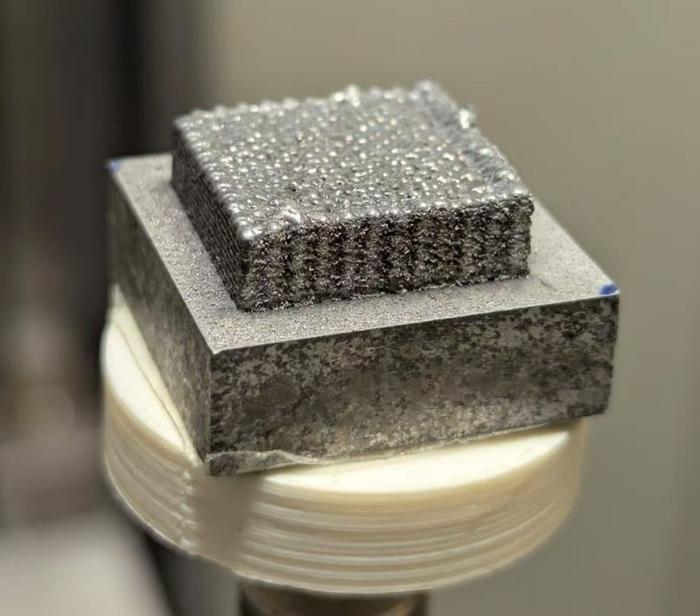
The challenge with DED printing is the thermal shock. The process is akin to high-tech welding, where a laser melts metal powder as it is deposited layer by layer. This results in cooling rates thousands of times faster than traditional casting. Standard alloys, such as the widely used AlSi10Mg, and other high-strength alloys often suffer from weak performance or poor processability in 3D printing. “The current development of 3D printing focused mostly on printing process; high-quality printing part should start from the materials,” said the authors.
To solve this, the researchers designed a “hypereutectic” alloy, essentially a metal recipe optimised to freeze in a specific and uniform way. By adding transition metals and rare earth elements, they created a material that solidifies with an incredibly fine microstructure matrix with uniform distribution of high-strength intermetallic particles. The grains within the metal are less than five micrometres across, with each grain containing an ultra-fine eutectic lattice structure less than 200 nanometres.
The results of this chemical tuning were dramatic. When compared to the standard AlSi10Mg alloy printed under identical conditions, the additive manufactured new material proved to be 70% stronger in yield strength and 50% stronger in ultimate tensile strength. Because the metal transitions from liquid to solid almost instantly (with a freezing range of just 2.8 °C), it leaves little time for the detrimental shrinking that causes cracks in other high-strength materials.
Crucially, the new alloy builds up very little internal tension as it hardens. Residual stress, the “ghost” forces trapped inside a printed part that can warp or crack it later, was measured at less than 32 megapascals, a figure the authors note is negligible compared to the material’s overall strength.
