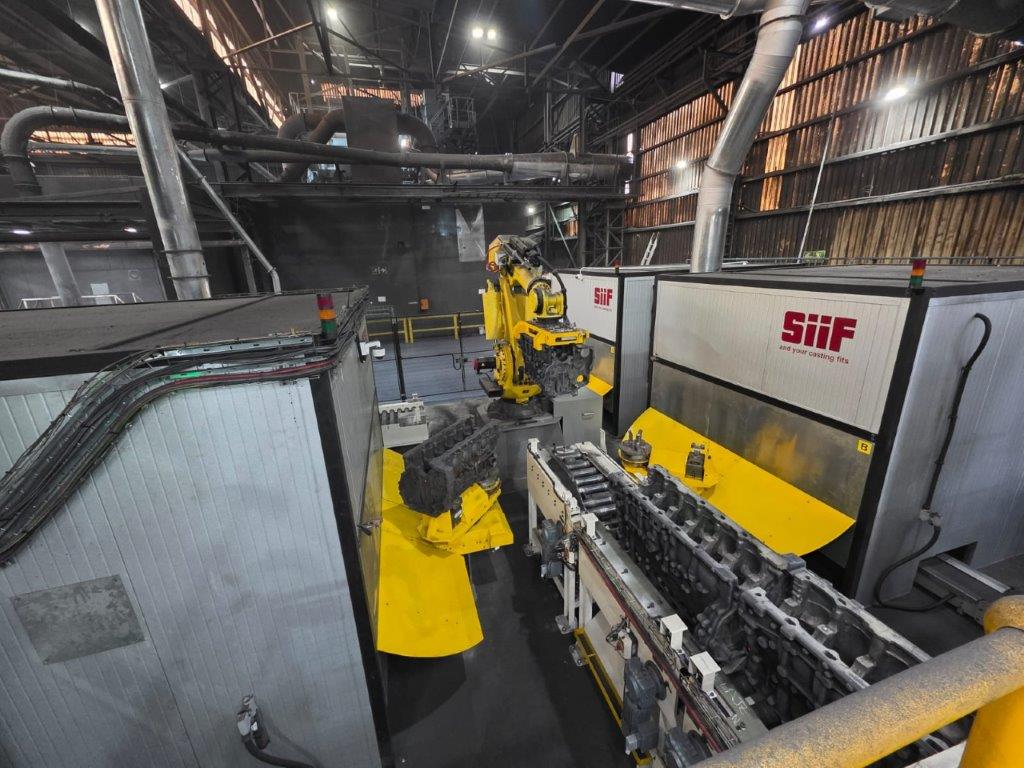
Three robotic cells setup to remove excess flash on engine blocks.
For nearly a decade, Atlantis Foundries has been a world-leader in implementing process improvements to their foundry operations, largely driven by the adoption of Industry 4.0 technologies and smart manufacturing processes.
This includes the adoption of automated moulding lines and the deployment of robots right through to artificial intelligence software to aid in the monitoring of casting defects. Over and above this, the foundry’s drive to go “green” will see it operating virtually off-grid via renewable resources very soon.
During this period environmental and workplace safety requirements have also been high on the agenda at Atlantis Foundries. And it is not just for the regulatory requirements and management that are easily identifiable. Back in 2019 Atlantis Foundries installed the company’s first Nederman MikroPul FS type filter for dust extraction and at the beginning of 2025 a second Nederman MikroPul FS type filter was commissioned, thus enhancing the air quality in the foundry and surrounds, while having the satisfaction that the working environment will not be compromised for staff. Management knew they had to be more proactive and go beyond these necessary solutions.
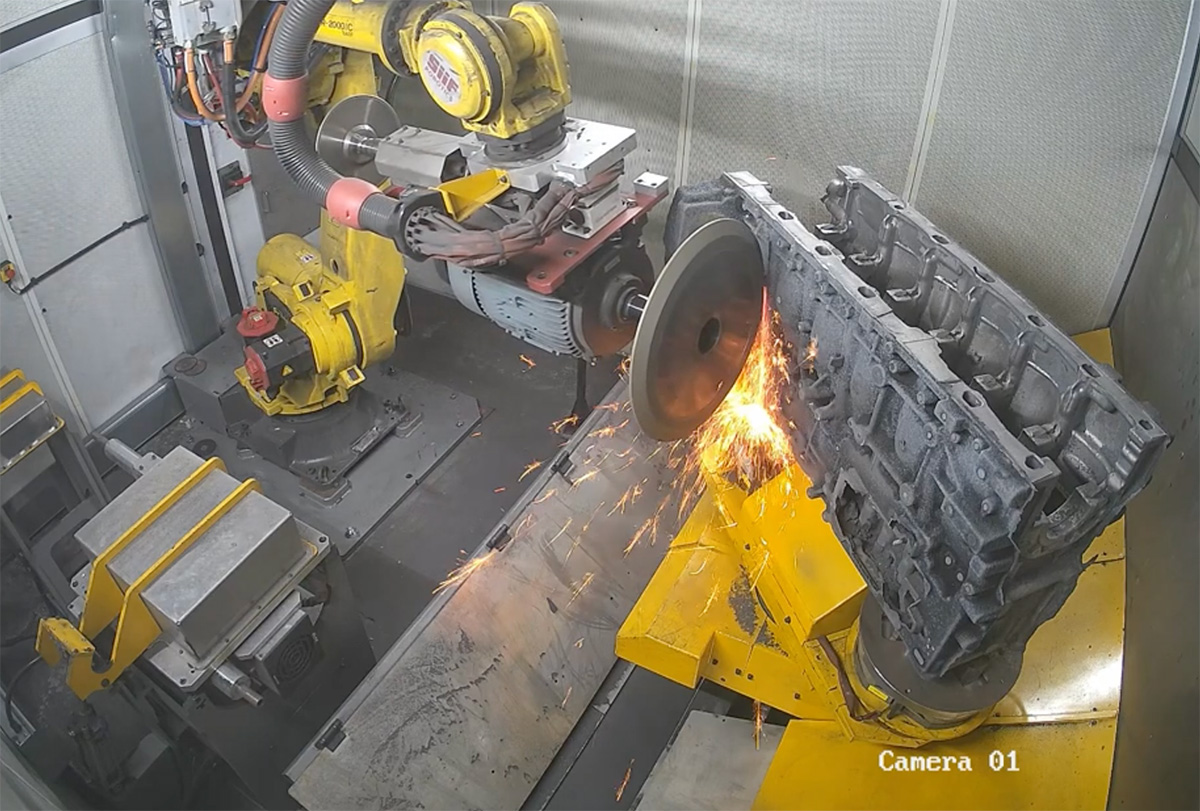
Atlantis Foundries has automated fettling of excess flashing of engine blocks. Supplied: Atlantis Foundries
It must be remembered that the metal foundry industry is fundamentally recognised as the backbone of industrial economies, supplying essential cast metal components to critical sectors including engineering, power, transportation, mining and manufacturing. With a large percentage of manufactured goods containing metal castings, this sector provides the necessary structural components, ranging from engine blocks and railroad components to industrial machinery, that enable the modern industrial world to function. If the goods do not contain metal, it is more than likely that they have been manufactured on equipment that is largely made up of components that have emanated from a foundry. For food items the same applies. In fact, if you look around you everything you see that has been manufactured or processed has a connection to a foundry.
Foundries are also one of the largest contributors to the manufacturing recycling movement, melting and recasting millions of tons of scrap metal every year to create new durable goods. Moreover, many foundries use sand in their moulding process. These foundries often use, recondition, and reuse sand, which is another form of recycling.
However, foundry owners and management must still be cognisant of the total environment that foundries occupy and ensure that the foundry operates in a manner that’s safe for the environment and protects public health, no matter how difficult the environmental regulations can be.
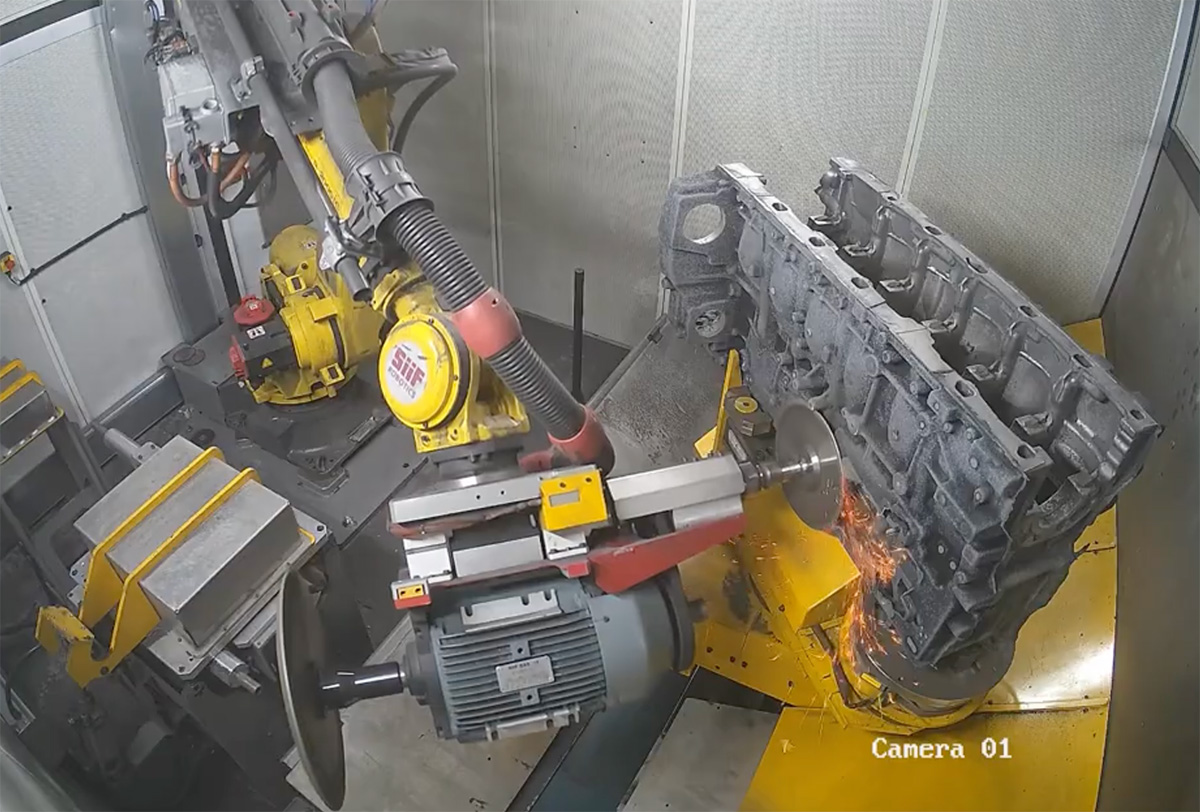
“A block exits the decoring cell via a conveyor system and is then handled by a Fanuc robot that can rotate the block 360 degrees. The block is then placed on a rotating fixture on top of a turntable which is located at the entrance/exit point of one of the stations in the three-station cell.” Supplied: Atlantis Foundries
Recent upgrades: Diesel storage
“We have recently completed our two new diesel dispensing stations that will more efficiently supply our onsite diesel needs,” said Atlantis Foundries’ Engineering Manager Mike Hartung.
“Previously the tanks that housed the diesel fuel were set below ground. Due to the environmental risk of potential underground leaks, these tanks are now housed above ground in self bunded tanks, within a bund. Aesthetic improvements were not the motivating factor, but the environment.”
“Underground fuel tanks are essential for fluid storage across various industries. However, we are aware that leaks from underground tanks can cause significant environmental damage, such as soil and groundwater contamination.”
“The construction of our new gas farm is now complete. The building safely houses four large LPG gas tanks. The tanks are covered with sand within the bricked structure and the area is similarly bunded.”
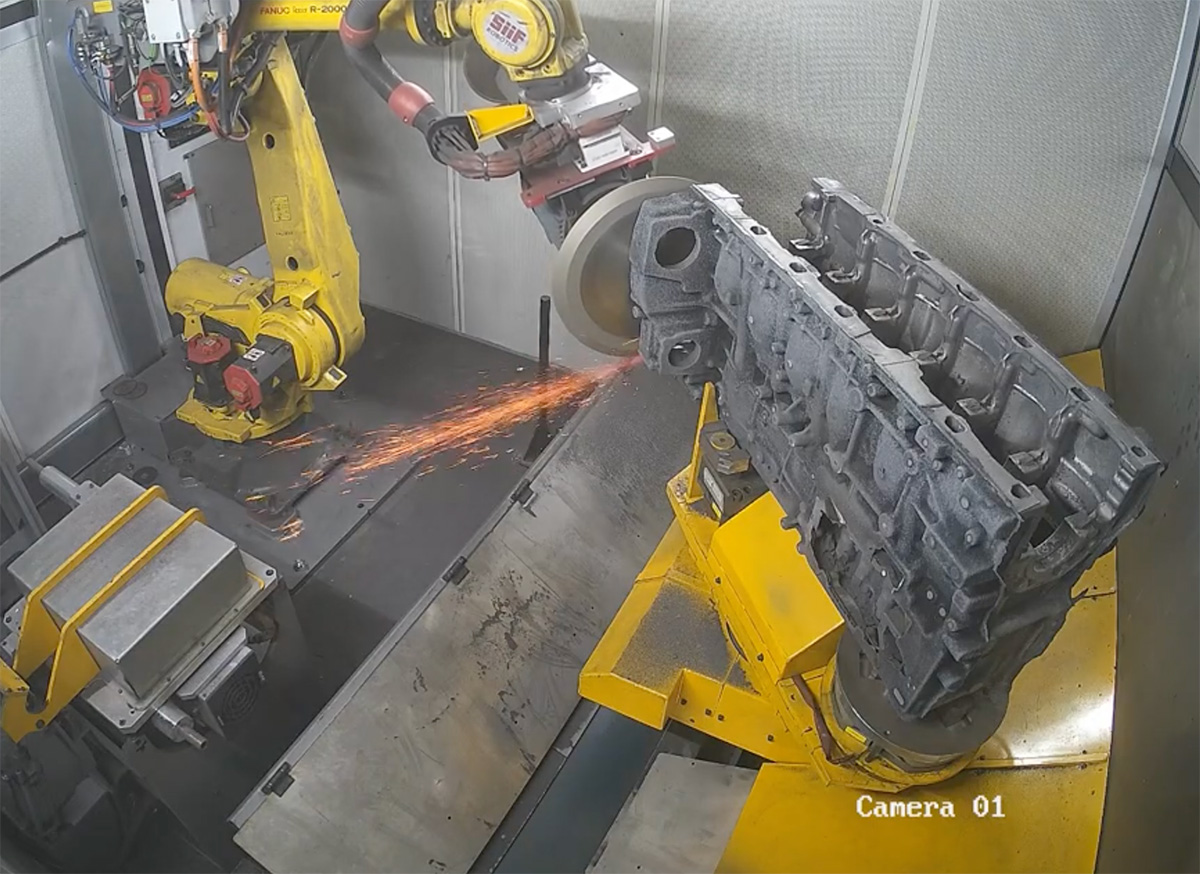
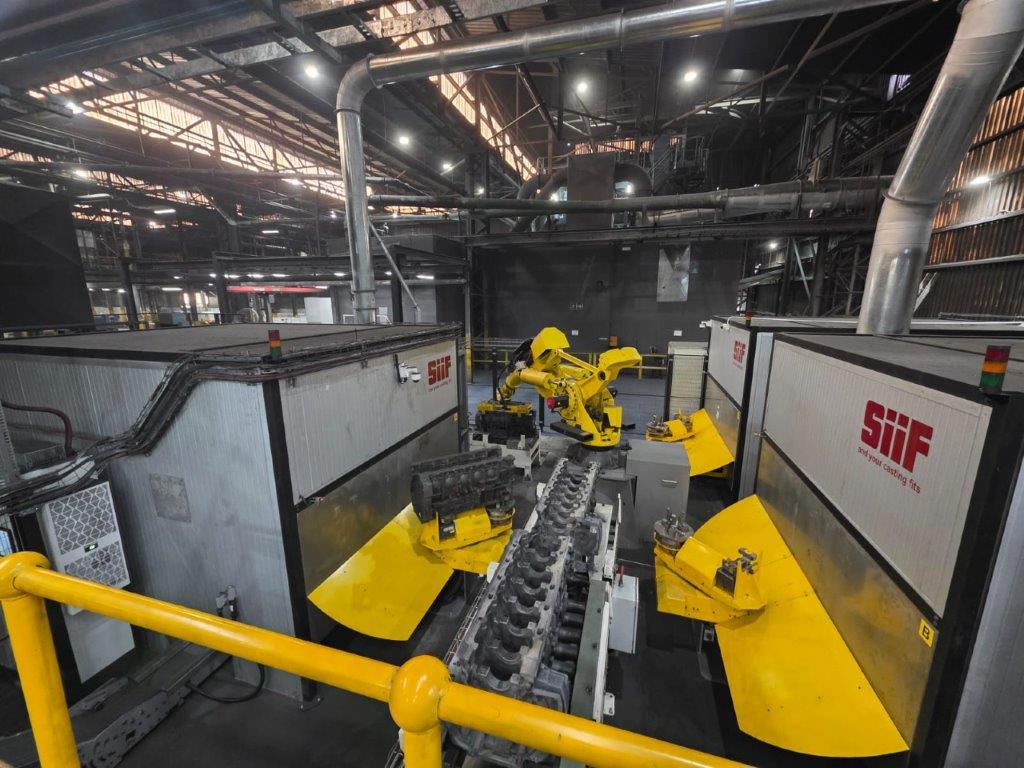
“The engine block is then rotated into the cell, and positioned so that the smaller robot, that holds the diamond coated fettling tools, can orientate the casting to the programme plane via a laser system prior to starting the fettling programme. The tooling also includes quick-change connectors for other necessary tooling.” Supplied: Atlantis Foundries
“Over and above this we have also constructed a specialised wash bay and spray booth for cleaning and painting our equipment such as machine parts. Here waste materials are washed off with high pressure hoses and all of the waste such as oils can be safely confined to a specific area and recycled appropriately, prior to final painting.”
“We have constructed a new building that has been put up over a bunded area where we will be storing all of the waste and oils. This building was designed to prevent hazardous substances from escaping into the environment, protecting the soil, water as well as the employees,” explained Hartung.
“We also had an area where all our steel rod, pipe and tube requirements were stored on the ground in the open. We have now constructed shelving and enclosed the area so the material is not exposed to the weather anymore.”
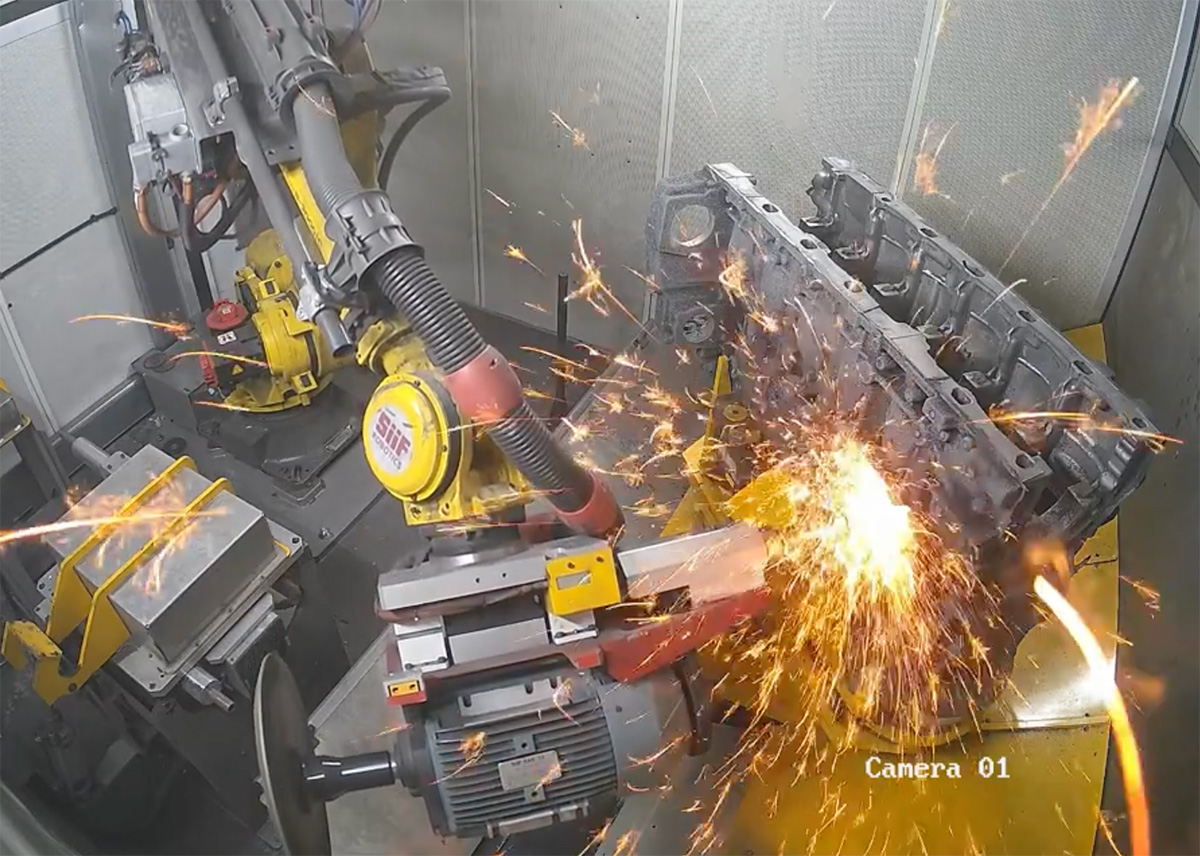
“This process is carried out on three sides of the block, each of them with a 75 second cycle time – 225 seconds in total. You cannot compare it to a manual operation. The time savings and productivity enhancements are enormous. All operations are monitored with cameras.” Supplied: Atlantis Foundries
“We have likewise enclosed the recently installed new rotary sprue cleaner drum to remove mould sand from casting runner systems in order to minimise slag formation during re-melting. With the implementation of the new drum, the waste material will be loaded into a lifting device and enter the drum where it will be rotated to remove the sand and dust and then come out clean at the end of the process when it is discharged from the drum.”
“From here it will be transferred to a bunker before being transported via the charging process to be re-melted and repoured. The new process also offers significant overall environmental benefits through the containment of the cleaning process.”
Coreshop resin transfer facility
“We have now built an offline and enclosed Part 1 and Part 2 pumping facility away from the factory floor in order to segregate and control these flammable and hazardous materials. This facility accommodates the resin in intermediate bulk containers, and both Parts 1 and 2 have a backup system. The resin is pumped to the coreshop mixers via stainless steel pipes, that are anti-corrosive and wrapped with insulated materials to keep temperatures even when transferring the chemicals, and are installed in existing overhead trays before entering the foundry facility.”
Automated fettling of excess flashing of engine blocks
“This is an area of processing and finishing that we have been looking at seriously and it has now come to fruition. Previously we lacked the consistency and productivity with manual deburring, not because of the employee capabilities, but rather the process they had to perform and the size of the casting – an engine block that weighs 450kg and more. Human intervention will never give you the same result.”
Supplied: SiiF
“We already started working on this project early in 2023. As part of the future project, Atlantis Foundries invested in fettling training and an R&D robot system that makes use of a Fanuc M900iC 700kg capacity robot to load blocks onto jigs using a Fanuc part identification and positioning camera. A smaller Fanuc R2000iC 210kg robot, equipped with a Fanuc spindle motor, is then used to fettle/trim the blocks of excess flash.”
“The R&D performed within this cell equipped us with the knowledge of what cutting tools and fettling accessories could be used on which portions of the block, in order to get the best results when we finally commissioned the automated fettling robot systems in the fettling department.”
“We engaged one of the leading developers and system designers of foundry finishing, fettling, deburring and grinding (SiiF), who also supplied the original decoring cell. The French company has now installed three cells directly after the decoring cell.”
“A block exits the decoring cell via a conveyor system and is then handled by a Fanuc robot that can rotate the block 360 degrees. The block is then placed on a rotating fixture on top of a turntable which is located at the entrance/exit point of one of the stations in the three-station cell.”
“The engine block is then rotated into the cell, and positioned so that the smaller robot, that holds the diamond coated fettling tools, can orientate the casting to the programme plane via a laser system prior to starting the fettling programme. The tooling also includes quick-change connectors for other necessary tooling.”
Supplied: SiiF
“This process is carried out on three sides of the block, each of them with a 75 second cycle time – 225 seconds in total. You cannot compare it to a manual operation. The time savings and productivity enhancements are enormous.”
“All operations are monitored with cameras.”
“After this fettling process the block is then transferred to inspection and powder coating, before transferring to machining, where a number of CNC machining operations take place on the blocks, then on to packing.”
“In the machining department three Heller CNC machines have been strategically placed to allow a 12m long robotic linear rail carrying a Fanuc M900iC 700kg capacity robot to run to each machine’s loading/unloading section. Two block infeed conveyors transport the blocks into the cell from where the robot collects them and places them into the correct CNC machine for machining. The same robot collects the machined blocks out of each CNC machine and places them onto an outfeed conveyor. This process was previously performed manually with blocks swinging from KBK overhead cranes. The robot has removed the danger of the operation and implemented control with predictability. Efficiencies have also rocketed and cycle times have been reduced to 90 seconds.”
“The new fettling cell also contributes to the environmental and health and safety aspects of the employees as there is less noise because the stations are enclosed and there are dust extractors, and the possibility of carpal tunnel is eliminated,” concluded Hartung.
For further details contact Atlantis Foundries on TEL: 021 573 7200
