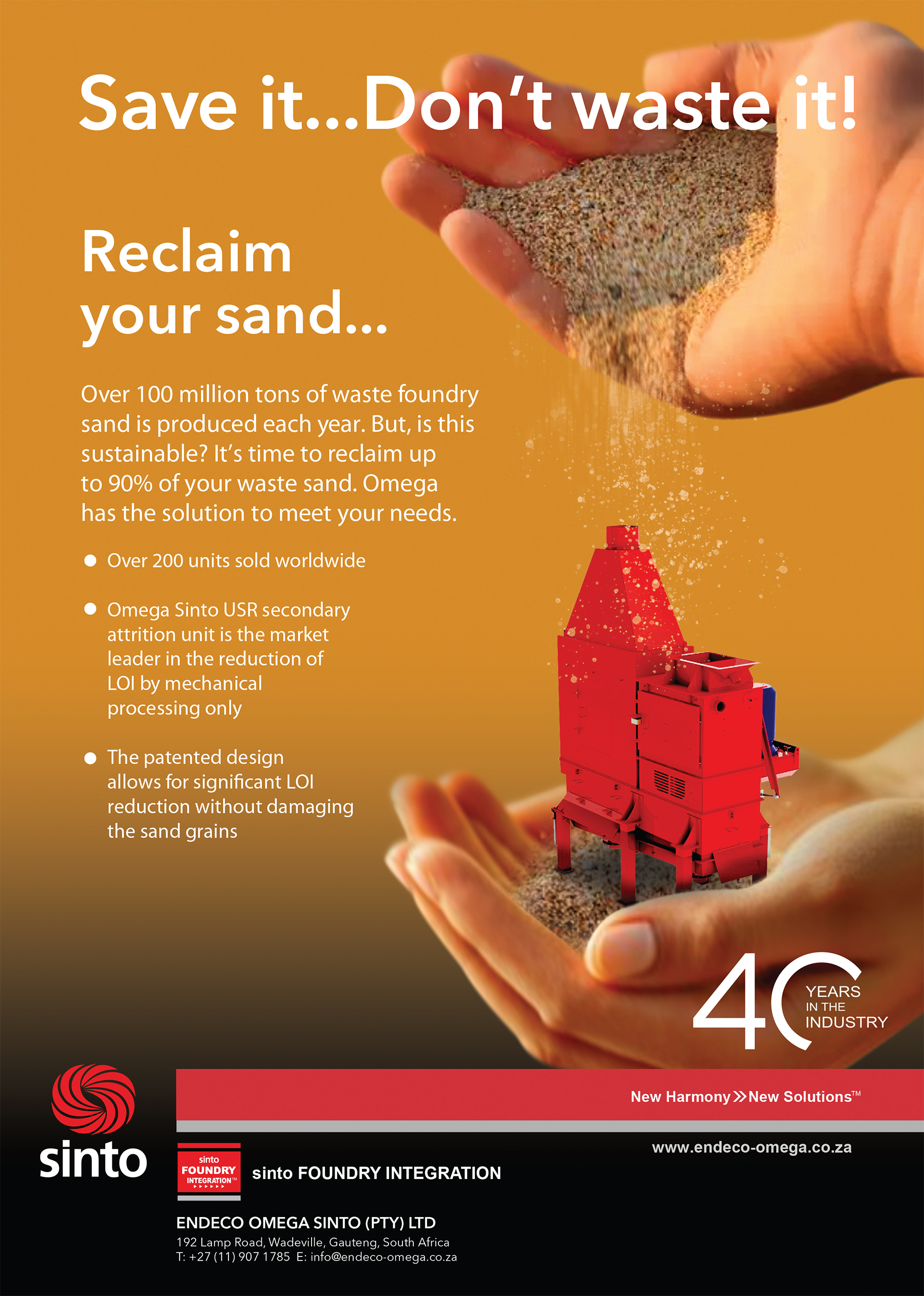
Also acquires Endeco Omega Sinto cooler, pressure vessel and dust extractor and 10-ton an hour continuous mixer.
Just over 10 years ago, Umgeni Iron and Steel Foundry was acquired by Malvern Engineering Works, a South African general engineering company servicing the mining industry and Minco Tech, an Australian based mineral processing and mining equipment manufacturing company based in Cardiff NSW, in a 50/50 joint venture.
The foundry, which is one of the oldest foundries in South Africa, produces castings for a number of industries and has a production capacity of 3 600 tons per year, made up of cast iron, steel, high-chrome iron, manganese steel and stainless steel.
Umgeni Iron Works, which is located in Sea Cow Lake Road, Umgeni, KwaZulu-Natal, was established in the late 1890s as Umgeni Engine Works, Foundry and Forge and operated in the premises of an old cotton mill on the southern bank of the Umgeni River, some half a kilometre from the present site. In January 1919, Umgeni Iron Works was established under the ‘Old Firms Act’ and took over the assets of the original company.
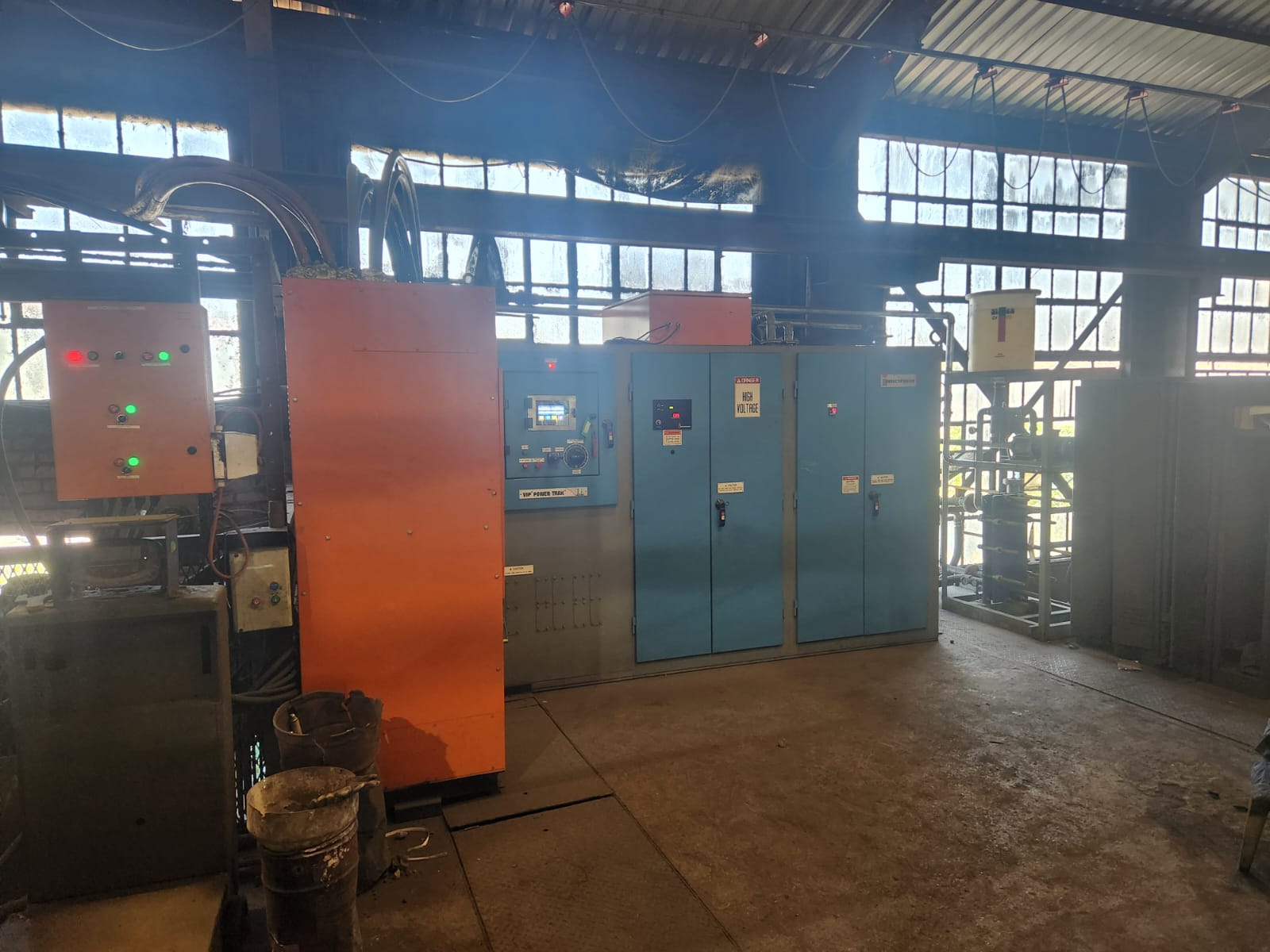
Umgeni Iron and Steel Foundry’s new Inductotherm VIP Power-Trak induction power supply system
Manufacturing at this time consisted of grey iron castings for farming, ship repair, brick making and general engineering applications. The need for development capital resulted in Umgeni Iron Works becoming a limited liability company in 1938, with a number of new shareholders.
To represent the market that the company was servicing the company name would subsequently change to Umgeni Iron and Steel Foundry. The company now serves the mining industry, sugar mills, shipping, brick works, smelters, general engineering and other metallurgical industries with a full range of 89 different specifications. The foundry can cast ferrous castings up to 5.5 to 6 tons in grey iron, SG iron and steel. Small amounts of stainless steel are also cast. In total the company casts on average 300 tons gross a month.
Facilities include patternmaking, and machining is undertaken by subcontracting to appropriately equipped companies in the greater Durban area. In accordance with industrial developments the formal quality management system ISO 9001 was first achieved in 1998 and has subsequently been upgraded to the various listings with the current one being ISO 9001:2015.
The foundry is also able to cast various grades of both bronze and aluminium and the company averages about 2 tons a month although currently they are experiencing a surge in bronze orders and are already up to 4 tons for the month of march 2026.
All materials are manufactured using virgin ingots and are all supplied with material certificates.
Regular castings made by Umgeni Iron and Steel Foundry include gear boxes, coupling boxes, ladle lids, slag launders, chrome cyclones, amongst others.
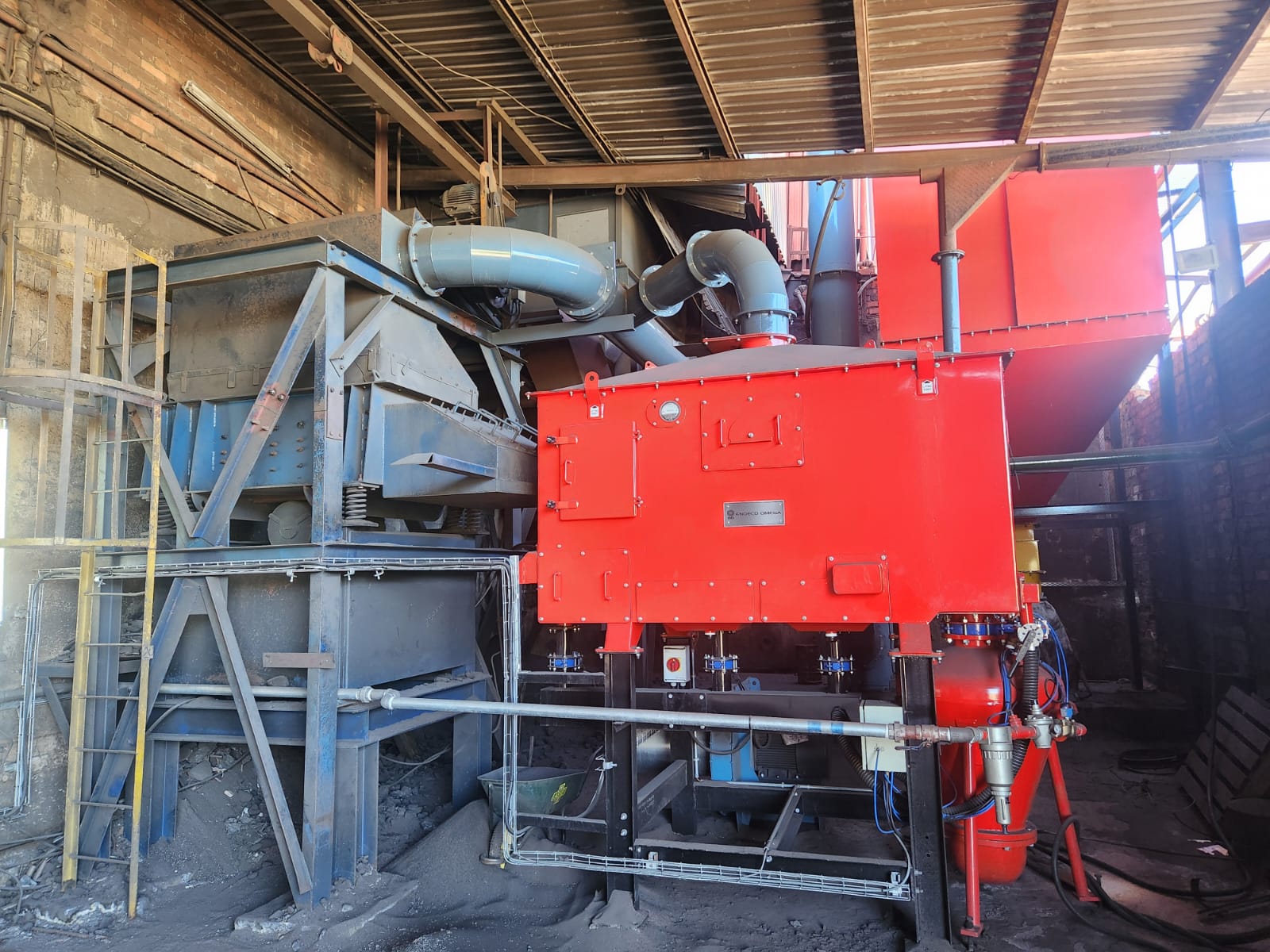
Another recent investment at Umgeni Iron and Steel Foundry was the installation of an Endeco Omega Sinto cooler, pressure vessel and dust extractor in the company’s sand department
Prior to the acquisition in 2015 the company was owned by the Rice family for 40 years with Gavin Rice being at the helm for the last 28 years. When Gavin decided to retire both his sons had already established successful careers and preferred not to continue the family interest in the business. Rice therefore decided to sell.
The acquisition by Malvern Engineering Works and Minco Tech was a strategic decision by the two companies, both of which have extensive exposure to the mining industry, to guarantee a continued supply of quality castings.
New equipment: New Inductotherm’s VIP Power-Trak induction power supply system Cerefco has recently completed the commissioning and start-up of a 1 250kW Inductotherm VIP Power-Trak Power induction power supply system for Umgeni Iron and Steel Foundry’s two 3.5 ton furnaces.
“The Inductotherm VIP Power-Trak induction power supply system that provides the power for the melting furnaces can be switched between either of the two furnaces that it is connected to,” said Umgeni Iron and Steel Foundry’s Foundry Manager Audy Bekker.
“The new Inductotherm system has replaced our original power system that was installed in 1983. It had served us well but eventually it becomes very expensive to maintain the system because of the inherent inefficiencies. Cerefco came and did a test in our foundry and showed us the significant gains that we could make in melt times and reliability, so much so that we had no choice but to invest. They installed the new Inductotherm VIP Power-Trak induction power supply system in December 2025 and we can now melt more metal in less time, with less power.”
“The Inductotherm VIP Power-Trak induction power supply units have one of the fastest melt rates from cold charge to pour, and melt more per kWh and kVA for lower melting costs and greater productivity,” said Bekker.
“We do have a number of other furnaces in the foundry which gives us the opportunity to cast our bronzes and aluminium requirements as well as the smaller castings in different materials.”
Cost savings in the sand department: Endeco Omega Sinto cooler, pressure vessel and dust extractor and 10-ton an hour continuous mixer Another recent investment at Umgeni Iron and Steel Foundry was the installation of an Endeco Omega Sinto cooler, pressure vessel and dust extractor in the company’s sand department.
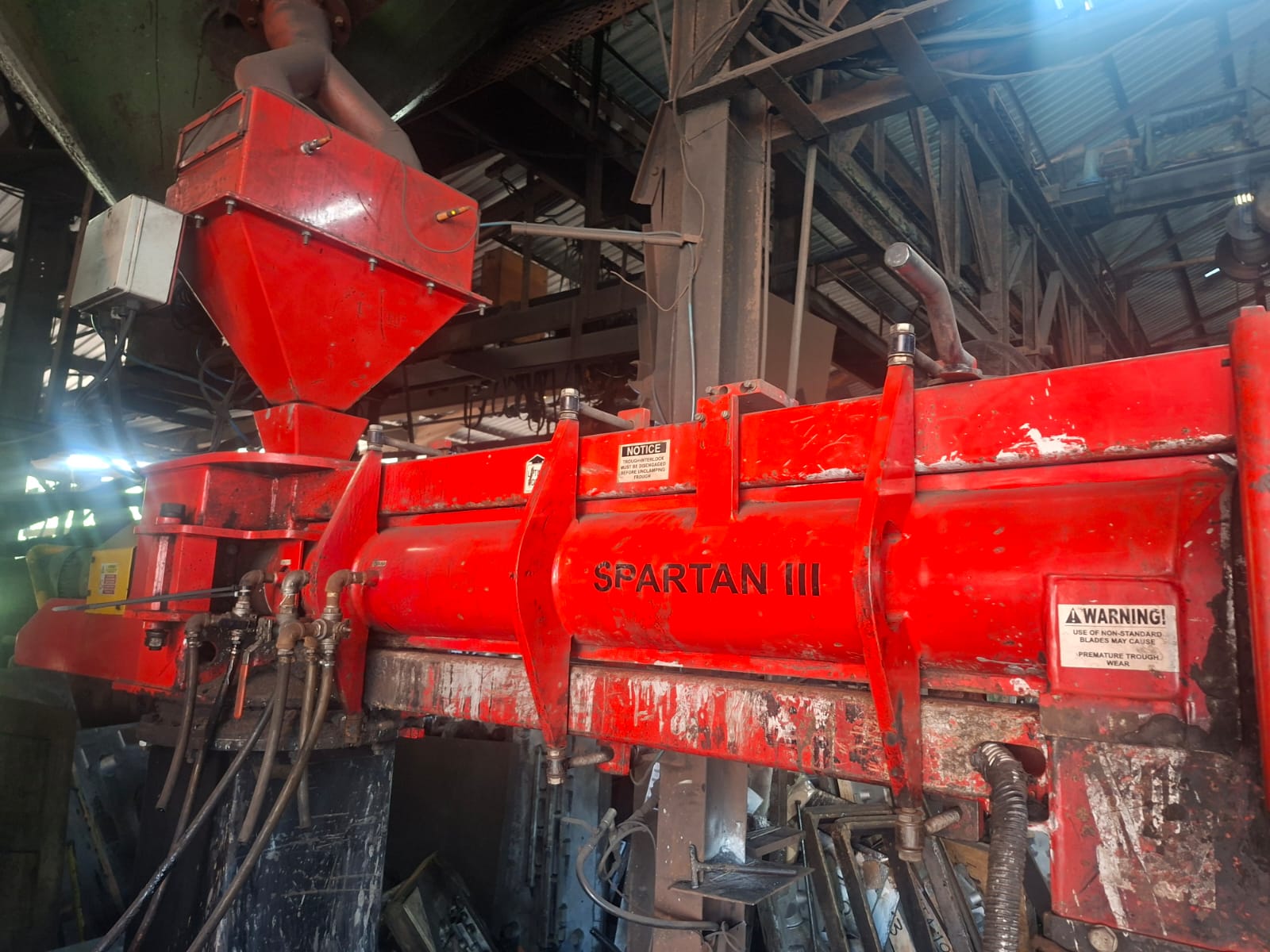
“Just over a year ago we modernised our sand mixing equipment with the installation of an Endeco Omega Sinto continuous mixer. Our chemical supplier supported us in acquiring the 10-ton an hour continuous mixer.”
“Today’s chemically-bonded sand metalcasting facilities are under increasing pressure to reduce costs and their impact on the environment, while improving and maintaining casting quality. One of the ways to meet these requirements is to invest in sand reclamation.”
“Cost reductions after installing sand reclamation equipment are made by reusing the sand after casting, buying less new sand and, with some systems, actually reducing the binder content at the mixer.”
“Three main options for sand reclamation include primary attrition, secondary attrition and thermal.”
“In order to reclaim the sand, the equipment must first reduce the lumps back to grain size, then remove all the coarse/agglomerated sand grains, dust and fines. The sand must be cooled before reuse, and a portion of the binder removed to stabilise the LOI.”
“Often overlooked, the sand cooler/classifier is equally as important as the attrition unit because unless we remove all of the dust and fine particles from the sand, we will not see a reduction in loss on ignition (LOI) at the mixer.”
“Typically, a cooler/classifier would be a fluidised bed type with a copper tube heat exchanger for sand cooling. The fluidising air and the extracted air must be finely balanced to provide a negative pressure inside the fluidising chamber. This pressure can be adjusted according to the amount of fines in the sand.”
“Fluidised sand is not abrasive; therefor copper tubes can be employed as the heat transfer medium. Using copper, the cooling system can cool the sand from 300C to within 6C of the water supply temperature.”
“While no two metalcasting facilities are the same and all have different sand systems and requirements, many variations of sand reclamation plants are available. All that has to be determined is the amount of binder removal required and the level of investment.”
Endeco Omega Sinto 10-ton an hour continuous mixer
“Just over a year ago we modernised our sand mixing equipment with the installation of Endeco Omega Sinto continuous mixer. Our chemical supplier supported us in acquiring the 10-ton an hour continuous mixer.”
“A sand mixer is a critical piece of equipment used in foundries and metalcasting operations to ensure a consistent and homogeneous mixture of sand and binders. This equipment plays a vital role in producing high-quality moulds and cores for casting processes by evenly blending the raw materials, thereby improving the strength, surface finish, and dimensional accuracy of the final castings.”
“Our investors – both Malvern Engineering Works and Minco Tech – have been very supportive on improving all the departments in the foundry with ready capital being provided for new equipment but also as clients with high demand for our castings,” concluded Bekker.
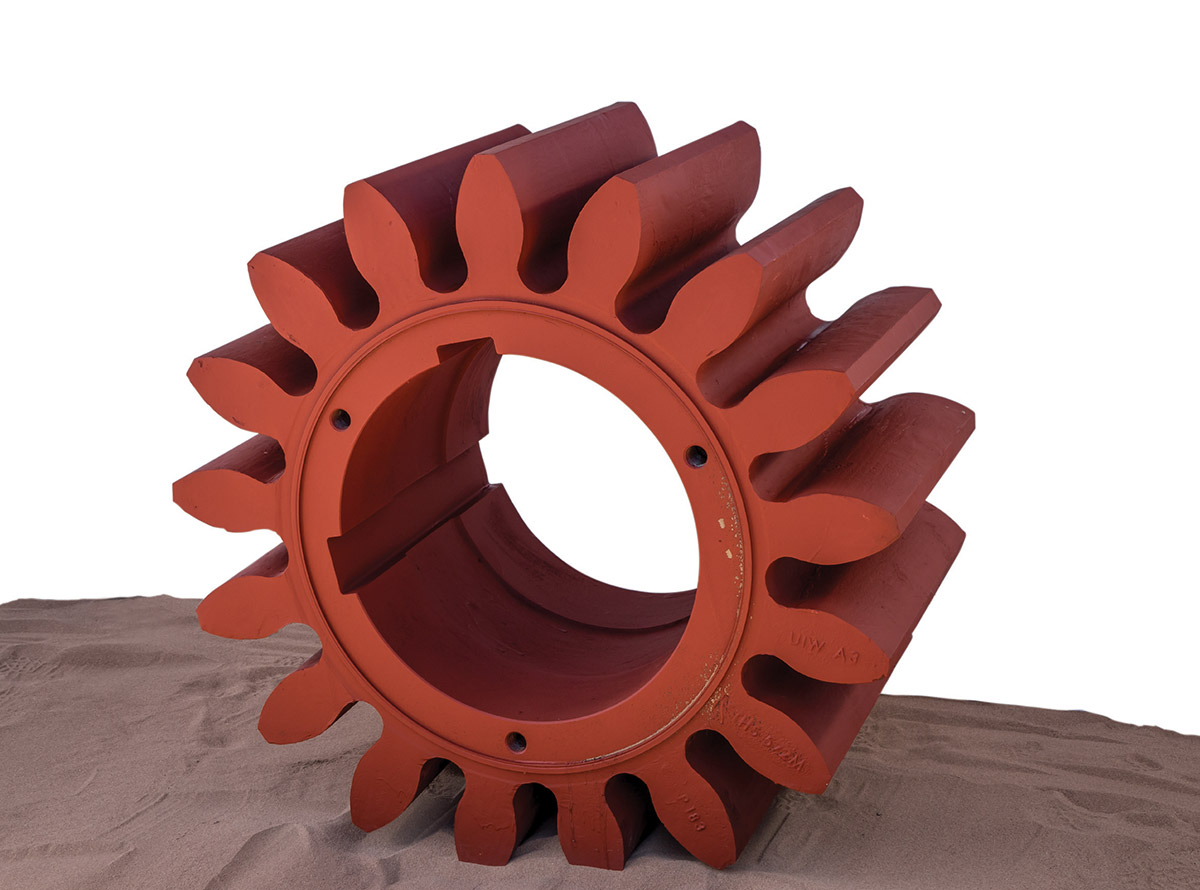
The foundry can cast ferrous castings up to 5.5 to 6 tons in grey iron, SG iron and steel. Small amounts of stainless steel are also cast. In total the company casts on average 300 tons gross a month
Malvern Engineering Works
Malvern Engineering Works was established in June 1947, as a general engineering business, servicing the mining industry. Over the years the company expanded, manufacturing a wide range of products such as sheave wheels, heavy media drum separators, medium and low intensity magnetic separators (for ore concentration), suspended electro and permanent magnets, cyclones, sieve bends and sampling systems. In-house designing of equipment started in 1980.
The company entered into strategic alliances with Ludowici (later acquired by FLSmidth) in 1996 for licensed manufacturing of fine and coarse coal centrifuges and with Minco Tech, Australia for heavy media and classifying cyclones in 2007. Malvern has sales agreements with Phoenix Process Equipment Co, Huzhou Hehui Machinery Co. Ltd and Shandong Haute Magnet Technology Co.
Malvern Engineering has seven group companies under its umbrella including Ingwenya Mineral Processing, Wedge Wire Industries, Schumar Engineering, Minco Malvern Process Equipment Company, Malvern Mozambique and Umgeni Iron and Steel Works.
Minco Tech
Minco Tech, a 100% Australian owned and operated company, have been designing and manufacturing mineral processing and mining equipment since 1978 and have been supplying their products into the Australian, South African, Indian and US markets.
For further details contact Umgeni Iron and Steel Foundry on TEL: 031 579 1361 or visit www.uiw.co.za